
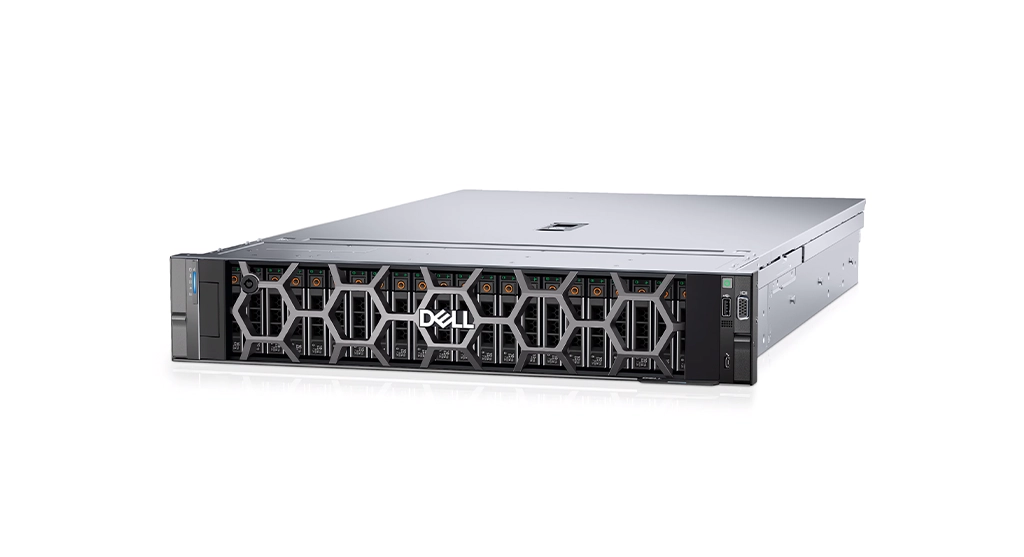
A global technology corporation suffered a critical failure on its Dell PowerEdge R740 server, which hosted a large RAID 5 storage array holding approximately 48 terabytes of sensitive enterprise data.
Multiple drives began reporting faults and the array collapsed, taking core research, intellectual property, and operational datasets offline.
With firmware corruption and physical media damage complicating the situation, the company engaged RAID Recovery Services for specialist Dell PowerEdge R740 RAID 5 data recovery to assess the incident and define a safe, controlled path to restoring the lost data.
Incident Background and Impact Assessment
The affected system was a Dell PowerEdge R740 configured with a RAID 5 array holding approximately 48 TB of enterprise data, including research assets, intellectual property, customer records, and internal communication archives. Day to day operations across multiple regions depended on this platform.
Over time, the server began to exhibit escalating symptoms:
Degraded performance and slower response times
Intermittent access issues on critical datasets
RAID alerts indicating drive instability and faults
Ultimately, two drives failed within the RAID 5 set. The array collapsed and the data became inaccessible.
This pattern aligns with multi drive incidents described in wider analyses of RAID data loss causes, where ageing or unstable disks quietly undermine redundancy and trigger sudden outages.
To understand why arrays often fail under sustained load, you can read more about common RAID data loss reasons in our article.
Key Diagnostic Findings
Our specialists carried out a structured diagnostic on the Dell PowerEdge R740 and its RAID 5 array.
Taken together, these findings confirmed a complex multi drive failure in which a normal controller level rebuild would almost certainly have led to permanent data loss.
In comparable scenarios, organisations are strongly advised to review best practice guidance for handling failed RAID rebuilds before making any changes on production systems.
To explore these risks in more depth, learn more about RAID rebuild data loss risks in our article.
Step by Step Recovery Workflow
Our team followed a controlled, multi stage workflow to protect the remaining data and rebuild the array safely.
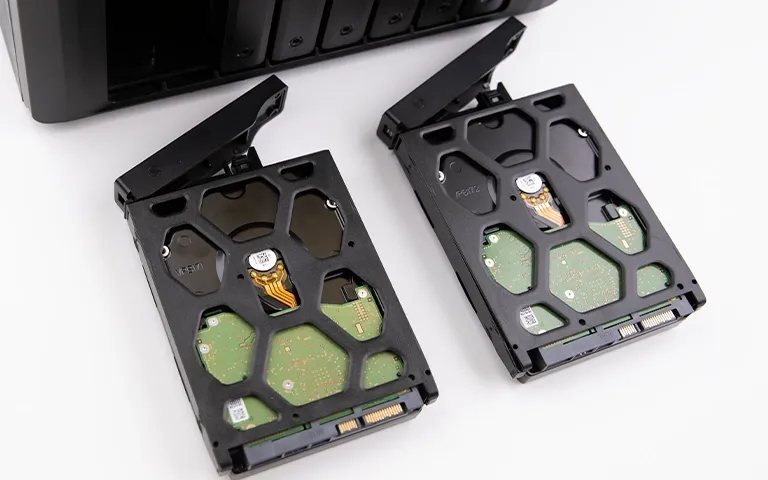
The Dell PowerEdge R740 was taken out of production. RAID configuration, controller settings, and log data were documented in detail to guide the reconstruction process.
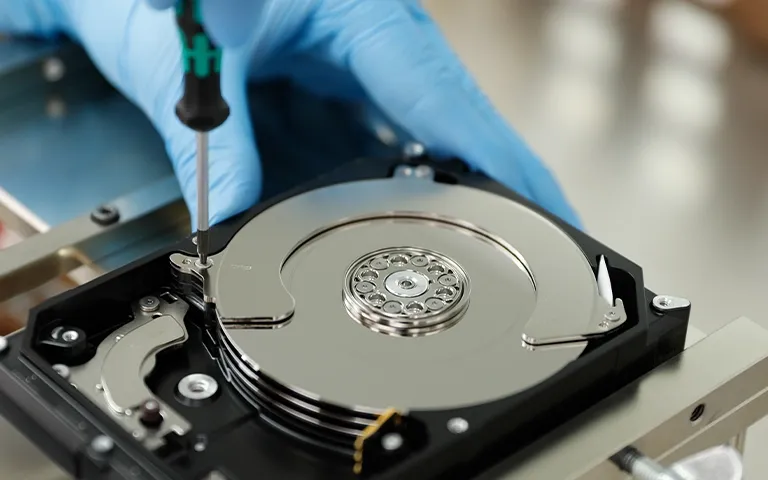
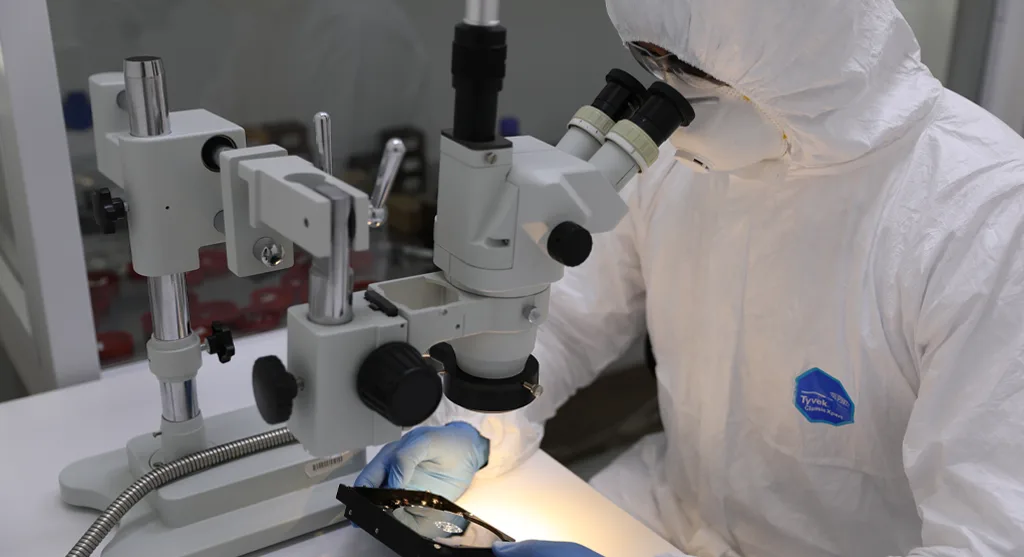
The drive with physical head damage was opened in a Class 10 cleanroom. Damaged read and write heads were replaced with compatible donor parts to restore temporary read access.
Drives affected by firmware corruption were processed using specialised in house tools, restoring access to user areas and service zones so they could be imaged reliably.
Each drive in the RAID set, including marginal units, was cloned sector by sector to new media. All further work was carried out on the cloned copies rather than the original disks.
Using the cloned drives, engineers rebuilt the RAID 5 set in a controlled lab environment. Stripe order, parity distribution, and block size were validated against known RAID configuration patterns used in enterprise servers.
For additional context on how these layouts are typically designed, you can read more about RAID configurations for servers in our article.
Once the virtual array was stable, volumes were mounted in read only mode and prepared for structured data extraction and integrity checks.
Critical Handling Advisory
If several drives fail in a RAID 5 set, do not run a controller rebuild or force disks online. This can overwrite good data. Power the server down, record the configuration, and have specialists work from forensic drive images, not the live system.
Fast turnaround times for business-critical data
Final Recovery Outcomes
The reconstructed RAID 5 array provided stable, read only access to the client’s data, enabling a controlled extraction of information from the virtualised Dell PowerEdge R740 environment.
Our team confirmed that core datasets, including proprietary research, intellectual property, customer databases, and internal communications, were accessible and structurally intact.
In total, approximately 98 per cent of the targeted data was recovered. Before handover, critical volumes and directories were validated using checksum comparisons and sample application level tests.
The recovered data was then transferred to secure replacement storage with clear documentation of structure and contents, allowing the client’s IT teams to reintegrate systems with minimal disruption.
Strategic Takeaways for Enterprise RAID Environments
RAID is not backup:
RAID helps keep systems online, but it does not replace independent backups. For a clear breakdown of the difference, read more in our article on RAID is not backup.Backups must be testable, not just configured:
Use both on premise and offsite or cloud backups, and run regular restore tests to prove they work in practice. For modern offsite strategies, see our guidance on server cloud backup.Act early on drive health warnings:
Monitor SMART data and error rates closely, and replace suspect drives before they start failing in groups and undermining redundancy.Keep RAID configuration well documented:
Record controller settings, RAID levels, stripe sizes, and drive order so that recovery teams can accurately reconstruct arrays after a failure.
Trust the experts with proven results
Frequently Asked Questions
What caused the RAID 5 array to fail on the Dell PowerEdge R740?
The core issue was multiple drive failures within the RAID 5 set, triggered by a combination of firmware corruption and physical damage on at least one disk. Because RAID 5 can only tolerate a single drive failure, the second failure caused the entire array to collapse.
Can a RAID 5 array be recovered after two drives fail?
In many cases, yes. If sufficient data can be imaged from the failed and marginal drives, specialist engineers can often reconstruct the RAID virtually and recover a large proportion of the original data.
Why is firmware corruption such a serious problem for recovery?
Firmware faults prevent the drive from exposing user data correctly, even when the platters are still readable. Without specialist tools, the disk may appear dead or inaccessible, blocking standard recovery approaches and masking the data that is still present.
Is it safe to try a rebuild from the Dell controller after multiple drives fail?
No. Initiating a controller level rebuild with unstable or corrupted drives can overwrite good data and significantly reduce the chances of a successful laboratory recovery.
How long does a case like this typically take to process?
Timeframes depend on array size, drive condition, and overall complexity. Multi drive, firmware related recoveries typically require several days to complete diagnostics, imaging, virtual reconstruction, and data validation.